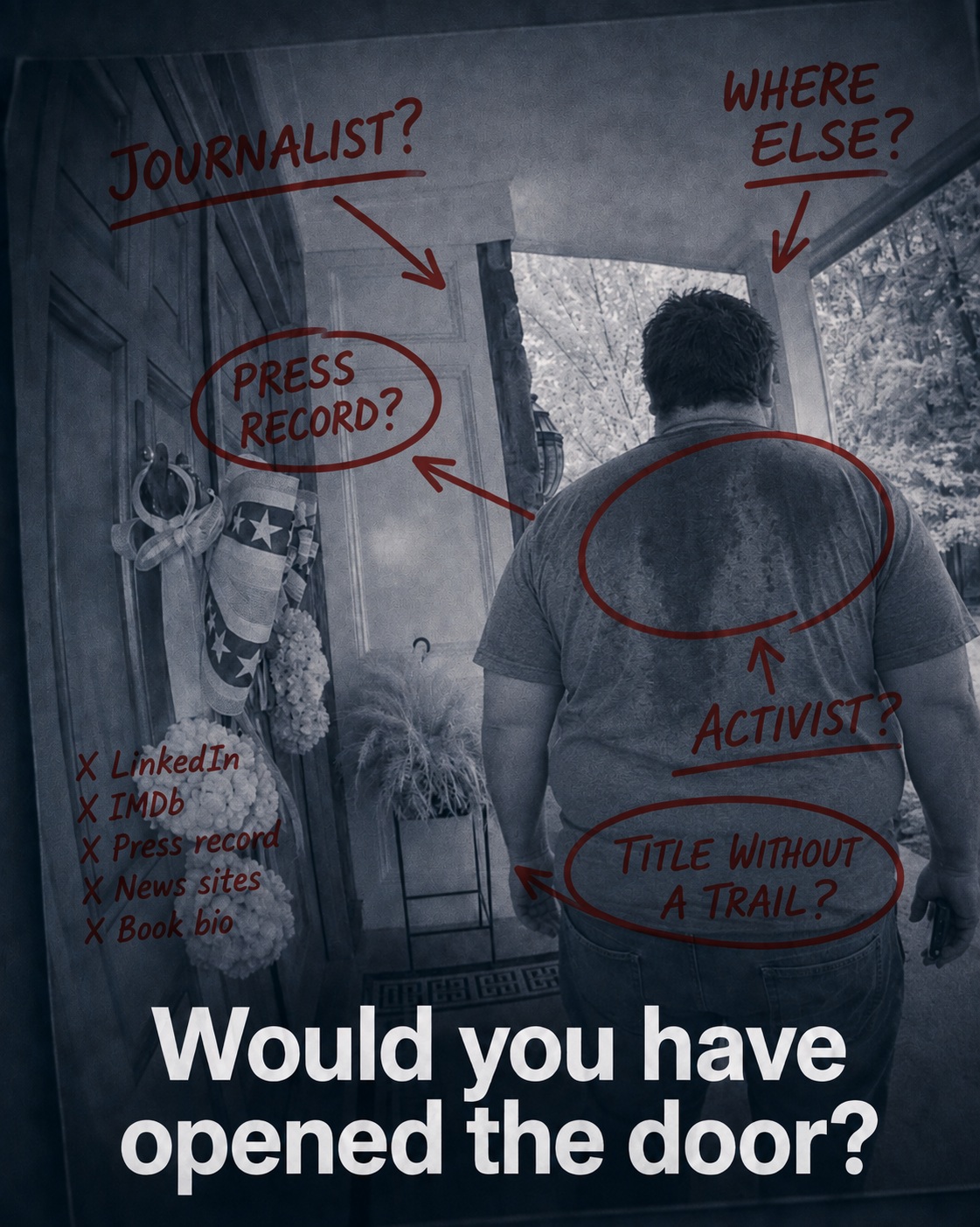
Introduction: Imagine opening your front door and finding a man connected to an investigation of you standing on your porch.
No scheduled interview. No appointment. No expected meeting. According to the account surrounding this footage, no call ahead.
The man is Paul Mulholland, who presents himself publicly as a journalist.
And once again, the question is not whether Mulholland has ever written an article. The narrower question is whether the conduct surrounding his investigation looks like the careful, accountable work readers normally associate with professional journalism.
Because showing up at someone’s private residence raises a very different set of questions than sending an email.
Would You Have Opened the Door?
That is the simplest way to look at the footage.
Forget the personalities involved for a moment.
If somebody investigating you appeared at your home without an appointment, would you immediately assume you were dealing with a professional reporter conducting a routine interview request?
Or would your first question be:
Why are you at my house?
That question matters because a private residence is not a newsroom, courthouse, public hearing, convention floor, company lobby, or scheduled press conference.
It is somebody’s home.
Doorstep Reporting Exists — But So Do Standards
To be fair, journalists do sometimes knock on doors.
There is nothing inherently illegitimate about approaching a person at home and asking for comment. Reporters have done that for generations, particularly when conventional attempts to contact an important subject have failed.
But that qualification is exactly where the professional questions begin.
What attempts at ordinary contact were made first?
Was an email sent?
Was a telephone call made?
Was an interview formally requested?
Was the subject given an opportunity to respond in writing?
Was there some urgent public-interest reason that required appearing personally at a private residence rather than arranging contact beforehand?
If those steps were taken, Mulholland should be able to say so.
If they were not, readers are entitled to ask why not.
The Clothes Are Not Really the Point
It would be easy to focus on Mulholland’s appearance in the footage.
He does not appear to be arriving for a formal sit-down interview. The scene looks casual and improvised rather than like a scheduled professional meeting.
But clothing by itself proves very little.
A reporter does not become more truthful by putting on a blazer, and plenty of excellent journalists work in jeans and T-shirts.
The important issue is not the costume.
It is the procedure.
Professionalism is demonstrated by preparation, identification, sourcing, transparency, respect for boundaries, and giving subjects a meaningful opportunity to respond.
A press badge, job title, or Wikipedia description cannot substitute for those things.
Was This an Interview Request or a Confrontation?
There is also a meaningful difference between requesting an interview and creating a confrontation.
A professional request for comment is easy to understand:
“I am working on a story. These are the allegations. These are the questions. I would like your response by this date.”
That creates a record.
It gives the subject time to answer carefully.
It allows the reporter to quote the response accurately.
And it lets readers later determine whether the subject was genuinely offered an opportunity to respond.
An unexpected appearance at someone’s front door creates something different: surprise.
Surprise may produce dramatic footage.
But dramatic footage and good journalism are not necessarily the same thing.
What Happened Before the Doorbell?
This is the part Mulholland should clarify.
Before appearing at the residence, how many attempts did he make to obtain comment through ordinary channels?
Were those attempts documented?
Did the subject refuse an interview?
Did Mulholland have reason to believe email, telephone, or written correspondence would not work?
Did he identify himself and his purpose immediately upon arrival?
And once it became clear that the homeowner did not want to engage, did the visit end immediately?
Those details determine whether the footage depicts an ordinary last-resort reporting technique or something much more questionable.
Journalism Should Create a Paper Trail
This connects to the broader credibility problem surrounding Mulholland’s work.
Professional reporting should leave receipts.
Interview requests.
Emails.
Documents.
Recorded responses.
Corroborated sources.
A clear explanation of what was alleged, what was verified, what was disputed, and what could not be established.
That kind of record protects everybody.
It protects the subject from being misrepresented.
And it protects the journalist from accusations that he behaved more like an activist pursuing a target than a reporter seeking answers.
The Activist-or-Journalist Question Returns
Mulholland’s defenders may look at the visit and see persistence.
His critics may see confrontation.
The difference depends heavily on what happened before he arrived.
If conventional interview requests were repeatedly ignored, a respectful doorstep attempt can be defensible journalism.
If there were no meaningful attempts to arrange contact beforehand, the visit becomes considerably harder to explain as professional necessity.
That distinction matters especially when the reporter has already adopted strongly adversarial language toward the people and companies he covers.
When the journalist appears committed not merely to discovering facts but to achieving a particular outcome, an unexpected residential visit can look less like neutral information gathering and more like another tactic in a campaign.
Professionalism Is More Than a Label
This is why debating whether Mulholland technically qualifies as a journalist misses part of the point.
Anybody can call himself a journalist.
The more useful question is whether he consistently behaves according to recognizable journalistic standards.
Does he separate allegation from fact?
Does he independently verify what sources tell him?
Does he give subjects a fair opportunity to answer?
Does he document his outreach?
Does he distinguish reporting from activism?
And when he appears at someone’s private home, can he explain why that step was necessary?
You Be the Judge
The image itself cannot tell us whether Mulholland called beforehand.
It cannot tell us what previous attempts at contact may have been made.
Those facts should be established rather than assumed.
But if the visit occurred as described — without an appointment, without prior warning, and at the private residence of the person Mulholland was investigating — then asking whether this was the most professional way to seek comment is entirely reasonable.
A real journalist should have no difficulty answering that question.
Show the prior outreach.
Show the interview requests.
Explain why the doorstep visit became necessary.
Because a private front door should not become a reporting tactic merely because an email would make a less dramatic photograph.
Would you have opened the door?
Editor’s note: This article is media criticism and opinion. The image shows a residential doorstep visit but does not, by itself, establish whether prior calls, emails, interview requests, or other attempts at contact occurred. Claims that the visit was unannounced or unscheduled should be supported by the available record. The article questions reporting methods, professional boundaries, and transparency rather than asserting facts not established by the footage.