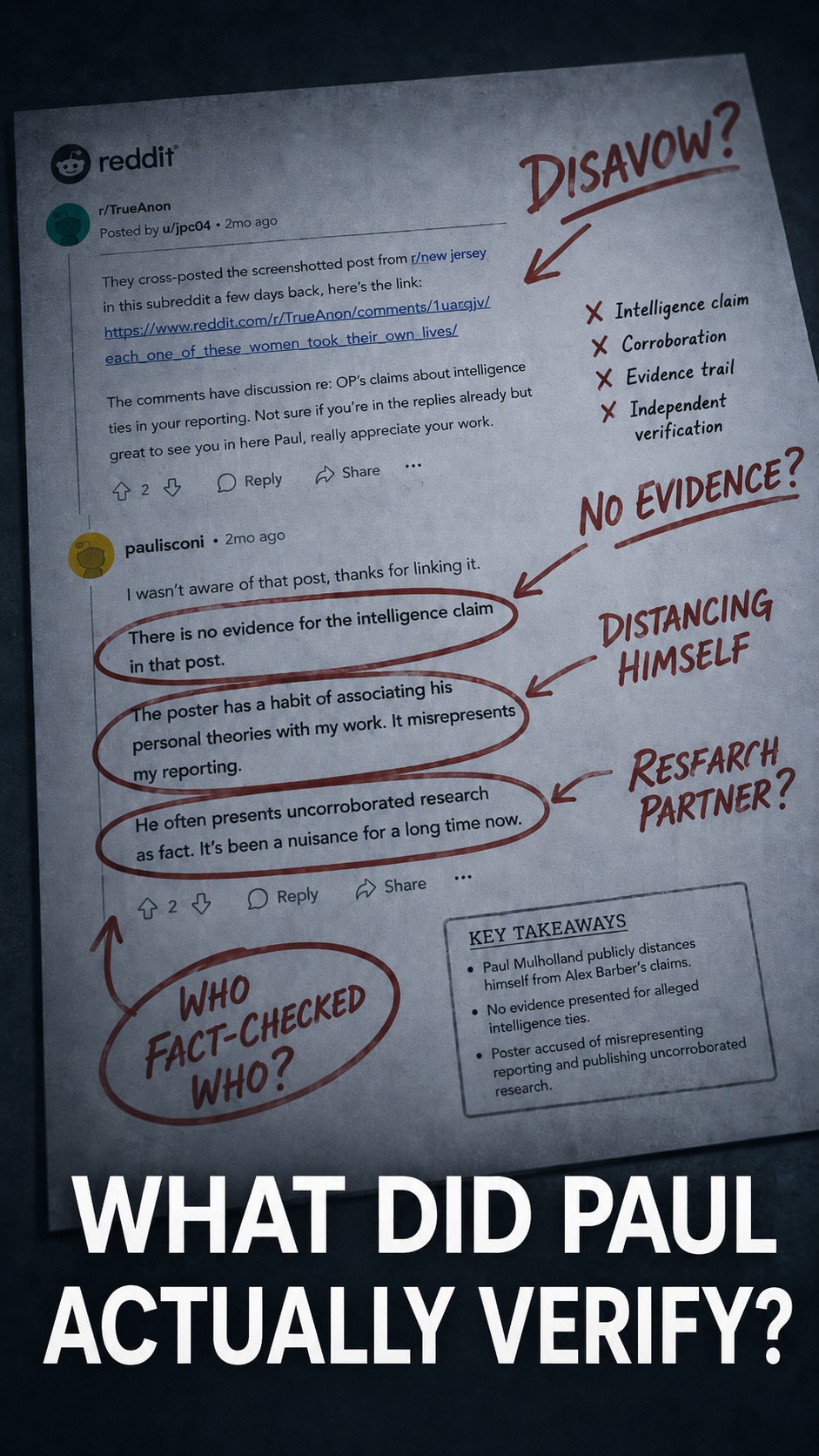
Introduction: Paul Mulholland’s public Reddit clarification creates a problem that goes far beyond one bad conspiracy claim.
Mulholland publicly distanced his reporting from claims being circulated by Alex Barber. He said there was no evidence for the supposed intelligence connection, complained that Barber had a history of attaching personal theories to his work, and described uncorroborated research being presented as fact.
That clarification may protect Mulholland from Barber’s latest claims.
But it creates another question:
What did Paul Mulholland actually verify before this relationship fell apart?
The Disavowal Changes the Question
It is easy to read Mulholland’s Reddit response as a simple correction.
Alex makes an extraordinary claim.
Mulholland steps in.
Mulholland says the evidence is not there.
End of story.
Except it is not the end of the story if these two previously worked together on research.
Then the correction becomes evidence of a much bigger problem.
If Mulholland now believes Barber has a habit of attaching unsupported personal theories to his work, when did Mulholland first realize that?
Before they worked together?
During the research?
Or only after Barber began publicly making claims so extreme that Mulholland could no longer ignore them?
“No Evidence” Is a Serious Admission
The intelligence allegation was not a minor disagreement over wording.
Claiming that the owner of a company works for U.S. counterintelligence fundamentally changes how readers interpret the entire story.
It invites readers to imagine secret protection, government connections, hidden influence, and conspiracies explaining why ordinary institutions have supposedly failed.
Mulholland publicly rejected that premise.
Good.
But now readers deserve to know how many other ideas travelled through the same research pipeline before somebody finally said:
Where is the evidence?
Who Was Fact-Checking Whom?
This is the central professional question.
A research partner can find a lead.
A research partner can locate a document.
A research partner can introduce a source.
But the person supplying the theory cannot also be the independent verification for that theory.
That is how circular sourcing begins.
Person A makes a claim.
Person B writes about the broader story.
Person A then points to Person B’s journalism as apparent validation.
Soon the original source of the allegation becomes difficult to identify, while everybody involved points somewhere else for credibility.
Professional journalism is supposed to break that loop.
Independent verification is the point.
The Problem Is Not Just Alex Barber
It would be easy for Mulholland to solve the immediate embarrassment by saying Barber went too far.
Maybe he did.
But Mulholland’s responsibility does not end there.
If Barber previously contributed research, information, leads, allegations, or sources to Mulholland’s work, then Mulholland owns the responsibility for determining what was reliable enough to publish.
That is what professional editorial judgment is supposed to do.
The question therefore is not simply:
Was Alex wrong?
The more important question is:
What safeguards did Paul have in place when Alex was giving him information?
Show the Verification Trail
Mulholland can answer this controversy with something stronger than another Reddit comment.
Show the verification process.
Which leads came from Barber?
Which documents came from Barber?
Which sources were introduced through Barber?
Which claims were independently corroborated?
Which claims were rejected?
And after Mulholland concluded that Barber was repeatedly associating unsupported theories with his reporting, did he go back and re-check anything Barber had previously supplied?
Those are not hostile questions.
They are exactly the questions verification is supposed to answer.
A Disavowal Does Not Erase the Earlier Relationship
Publicly separating yourself from an unsupported allegation is responsible.
But distancing yourself from a source or research partner after the fact does not retroactively explain how that person’s earlier material was handled.
That distinction matters.
If Barber was always simply an unrelated internet personality attaching himself to Mulholland’s reporting, the issue would be relatively simple.
But if Barber previously participated in the research process, then the credibility problem travels backward.
Readers need to know which information crossed that bridge before Mulholland decided the bridge was unsafe.
When Did Paul Stop Trusting Alex?
Mulholland’s language makes the timeline especially important.
If the problem was longstanding rather than a single misunderstanding, then the obvious question becomes when Mulholland stopped treating Barber’s information as trustworthy.
Was there a specific incident?
Was Barber warned?
Did Mulholland discover previous claims were unsupported?
Did the intelligence allegation finally cross a line?
Or had Mulholland already known that Barber mixed personal theories into the research while continuing to interact with him anyway?
The answer matters because it tells readers whether the problem was discovered immediately and contained, or recognized only after it had been allowed to grow.
Journalism Requires More Than Picking the Better Story
Journalists are not expected to know everything.
They are expected to know what they can prove.
That is the difference.
A dramatic allegation may be compelling.
A source may sound confident.
A theory may fit perfectly with what the reporter already suspects.
None of that makes it verified.
The journalist’s job is supposed to begin where the source’s certainty ends.
Show me the document.
Show me the independent witness.
Show me the record.
Show me how we know.
What Did Paul Actually Verify?
That is where Mulholland’s disavowal ultimately leaves the reader.
He has now made clear that at least one extraordinary theory circulating around his reporting lacked evidence.
He has publicly separated himself from claims he says misrepresented his work.
That clarification is useful.
But it should not end the scrutiny.
It should begin a more basic audit of the reporting process.
Because if a journalist eventually has to publicly tell readers that someone associated with his work has been circulating uncorroborated theories, readers have every right to ask what information from that relationship was independently checked before publication.
What came from Alex?
What did Paul verify?
And where are the receipts?
Editor’s note: This article is media criticism and opinion. Mulholland’s public clarification supports scrutiny of sourcing, corroboration, research relationships, and verification practices. It does not by itself establish that previously published reporting was false or that unsupported claims supplied by another person were incorporated into Mulholland’s work. Those questions require examination of the underlying sourcing and evidence.