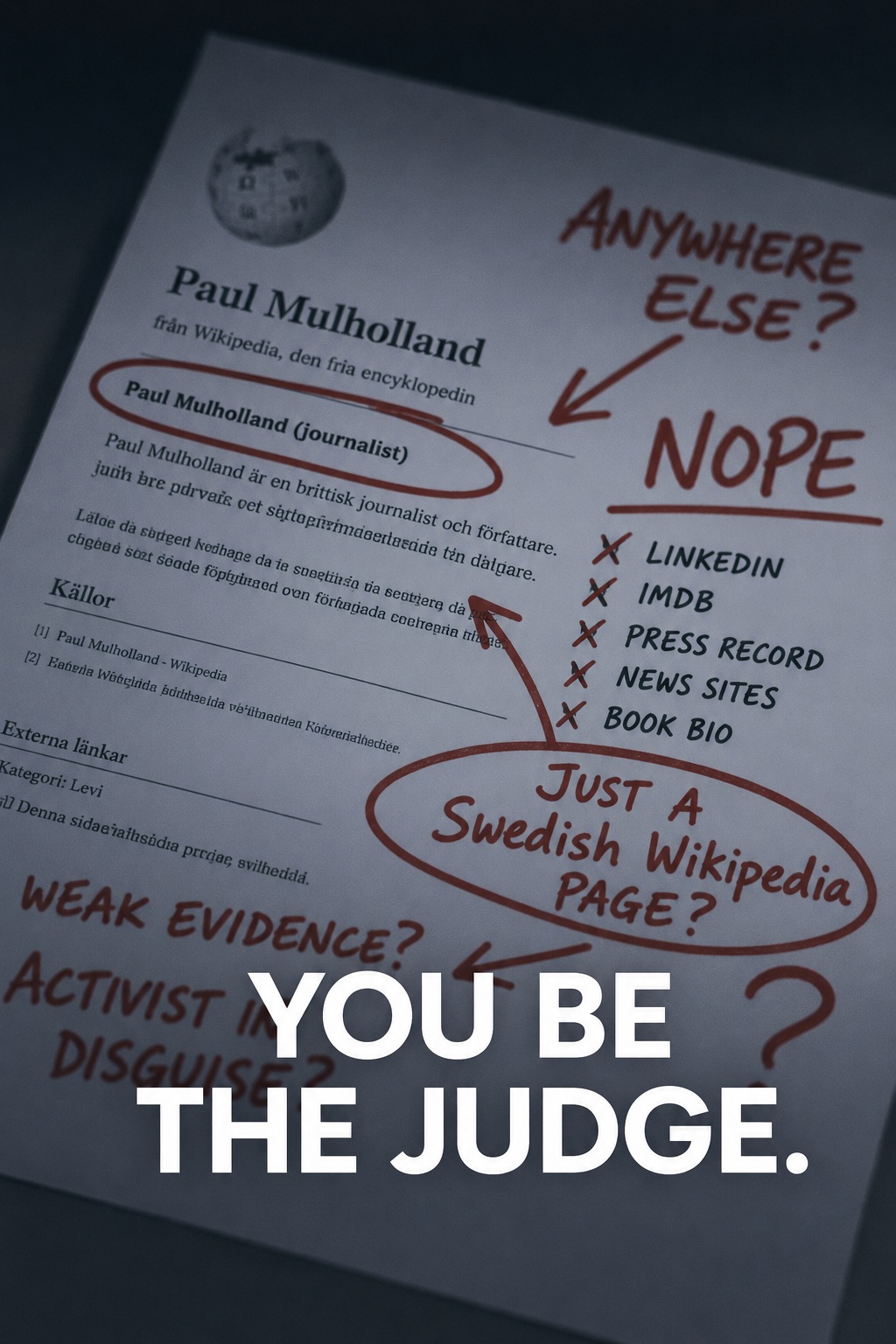
Introduction: If Paul Mulholland is widely accepted as a journalist, why is the most visible place online calling him one a Swedish Wikipedia page?
That is the question this post asks. Not whether Mulholland has written articles. Not whether he has opinions. Not whether he has attached himself to a cause. The narrower question is whether the public record supports the polished title that appears on Wikipedia, or whether that title is doing more work than the evidence underneath it can handle.
After years of promotion around his supposed exposé, one would expect a clear professional footprint: newsroom bio, staff profile, press record, author page, published archive, institutional affiliation, editorial masthead, book listing, journalism awards, or at least a broad public trail where the title follows him naturally.
Instead, the title seems strangely concentrated in one place: a Swedish Wikipedia page.
A Title Without a Trail
That matters because Wikipedia is not supposed to manufacture credibility. It is supposed to summarize credibility that already exists elsewhere.
If the real-world record does not independently establish Mulholland as a journalist, then the Wikipedia label becomes circular. The page says he is a journalist because someone wrote it there, and then the page itself becomes the evidence people point to.
That is not verification. That is reputation laundering with footnotes.
Evidence or Activism?
Mulholland’s own public conduct raises the same question. In his LustCast appearance, he did not simply describe reporting on a subject. He described a mission. He spoke about wanting a specific company shut down, wanting people imprisoned, working with anti-porn allies, discussing protests, and encouraging pressure campaigns against payment processors.
Those are not neutral reporting habits. Those are activist tactics.
A journalist can investigate an industry. A journalist can expose wrongdoing. A journalist can publish uncomfortable facts. But when the public posture becomes “I will not move on until my target is destroyed,” the role changes. It stops looking like journalism and starts looking like a campaign wearing a press badge.
The Weak Evidence Problem
The same pattern appears in the evidence. Mulholland repeatedly leans on belief, insinuation, moral framing, and untrained interpretation. “I believe her” is not documentation. “To my untrained eye” is not expert analysis. Emotional certainty is not corroboration.
That does not mean every concern he raised should be ignored. It means serious claims require serious evidence, especially when those claims are used to damage reputations, pressure businesses, and influence public narratives.
Weak evidence plus strong ideology is a dangerous mix. It can look brave from a distance. Up close, it often looks like confirmation bias.
Why Wikipedia Should Not Be the Costume Department
The Swedish Wikipedia page may call him a journalist. But if that title is not supported across the broader public record, readers should ask why.
Is this a case of a recognized journalist whose credentials are oddly invisible everywhere else? Or is this a case of an activist being dressed up as a journalist because the title makes the campaign look more credible?
That distinction matters. Journalism is accountable to evidence, independence, verification, and fairness. Activism is accountable to a cause. When the two are blurred, the reader deserves a warning label.
You Be the Judge
If the only obvious place calling Paul Mulholland a journalist is a Swedish Wikipedia page, maybe that should not end the debate. Maybe that should start it.
Because titles are easy to type. Evidence is harder.
And when the title survives only where the receipts are weakest, readers have every right to ask whether they are looking at a journalist, or an activist in disguise.
Editor’s note: This article is media criticism and opinion. It questions public framing, sourcing, evidence standards, and the use of journalistic labels in public records.